

In recent years, a new wave of financial platforms has emerged—prediction market apps. These platforms allow everyday users to make money trading on the outcome of real-world events, turning opinions and insights into potential profit.
Instead of buying stocks or crypto, you’re essentially trading on whether something will happen or not, from elections and sports results to bitcoin price. Infact recently, Techcrunch published a blog post on how some prediction market app users made a profit of $1 million from a prediction tied to bombing of Iran.
What Are Prediction Markets?
Prediction markets are financial markets for forecasting outcomes.
Instead of trading assets like stocks, users trade contracts tied to real-world events, such as:
- Will a candidate win an election?
- Will Bitcoin reach a certain price?
- Will a team win a championship?
- Will inflation rise next quarter?
How It Works
On prediction markets, you typically:
- Buy YES contracts if you believe an event will happen
- Buy NO contracts if you believe it won’t
Each contract has a price (e.g., $0.40 or $0.70), reflecting the market’s belief in the probability of that event.
👉 If your prediction is correct:
- You get paid
👉 If you’re wrong:
- You get nothing
Think of it as crowd-powered forecasting, where prices reflect collective intelligence.
Prediction Market Apps
Prediction market apps are digital platforms that allow users to trade contracts based on the outcome of real-world events.
They function similarly to financial markets, but instead of stocks or commodities, you are trading probabilities of events happening.
Two of the most popular platforms in this space are Polymarket and Kalshi prediction market. In this guide, we’ll focus more on Polymarket while also comparing it with Kalshi.
What Is Polymarket Prediction Market?
Polymarket is a decentralized prediction market platform that allows users to trade on real-world events using cryptocurrency.
It’s one of the most popular platforms in this space due to its simplicity, transparency and wide range of markets.
Key Features of Polymarket
- 📊 Trade on politics, crypto, global events and more
- 🔗 Built on blockchain (Polygon network)
- 💸 Uses stablecoins (like USDC)
- 📉 Real-time market pricing based on user sentiment
- 🌍 Open to users globally (with some restrictions depending on location)
Example
You might see a market like:
“Will inflation increase in Q3?”
- YES = $0.65
- NO = $0.35
This means the market believes there’s a 65% chance the event will happen.
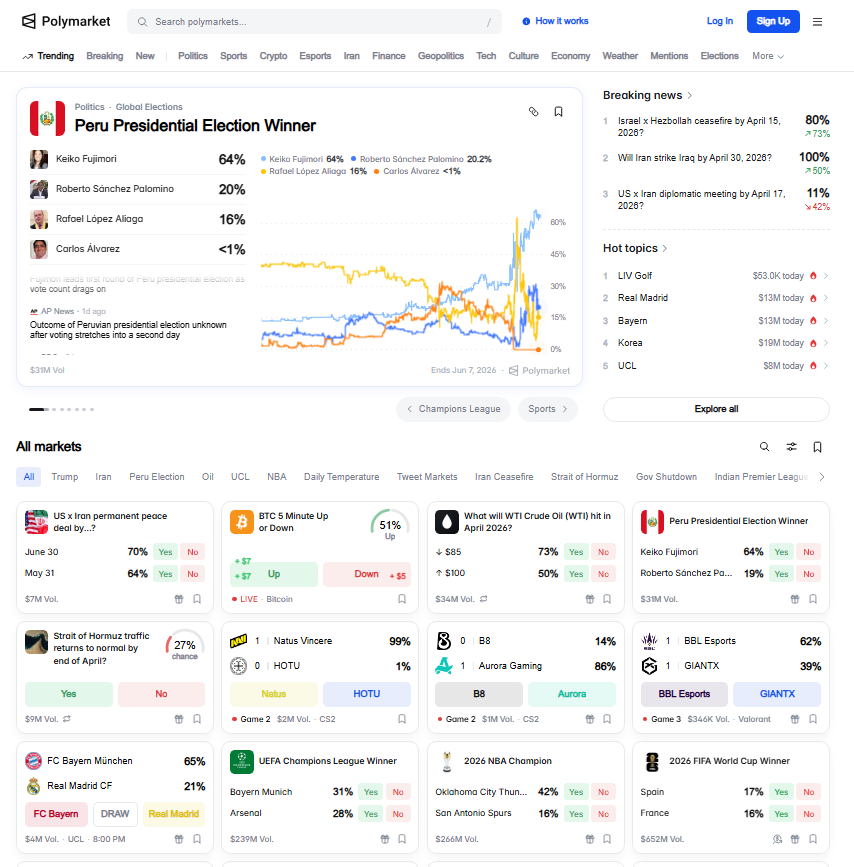
How Does Polymarket Works?
Pick a Polymarket
Buy ‘Yes’ or ‘No’ shares depending on your prediction. Odds shift in real time as other traders get in on the action.
Place a Trade
Fund your account with crypto, debit card or bank transfer—then you’re ready to trade.
Redeem
Sell your ‘Yes’ or ‘No’ shares at any time, or wait until the market ends to redeem winning shares for $1 each. Create an account and place your first trade in minutes.
Polymarket App Download
For a long time, Polymarket was strictly a web-based platform, but they have recently expanded their mobile presence to meet the massive demand of mobile traders.
Official Apps: You can now find the official Polymarket app on both the Apple App Store (iOS) and Google Play Store (Android).
Getting Started: Once downloaded, you’ll fund your account using USDC (a crypto stablecoin pegged to the US Dollar) rather than traditional fiat currency, keeping transactions fast and borderless.
How Does Polymarket Make Money?
Polymarket makes its money by charing a small taker fee on certain markets. These fees fund the Maker Rebates Program, which redistributes fees daily to market makers to incentivize deeper liquidity and tighter spreads.
Geopolitical and world events markets are fee-free. Polymarket does not charge fees or profit from trading activity on these markets. There are also no Polymarket fees to deposit or withdraw USDC (though intermediaries like Coinbase or MoonPay may charge their own fees).
You can read more about Polymarket fees.
Polymarket vs Kalshi Prediction Market
Kalshi is the preferred choice for US-based traders seeking a fully regulated platform, while Polymarket is ideal for crypto-native users and international markets.
The real difference between both is fees, deposit method and access.
Choose Kalshi for open access and fiat funding; choose Polymarket for lower fees and crypto-native trading
Why Prediction Market Apps Are Growing Fast
Prediction markets are becoming popular because they combine:
- Financial opportunity
- Real-world knowledge
- Crowd intelligence
Benefits
- Opportunity to earn from predictions
- Reflect real-time public opinion
- Encourages research and critical thinking
Final Thoughts on Prediction Market Apps
Prediction market apps like Polymarket are reshaping how people interact with global events.
Instead of just watching the news, you can now:
👉 Trade your knowledge and insights
However, always approach it wisely:
- Start small
- Learn the system
- Never invest money you can’t afford to lose



Leave a Reply